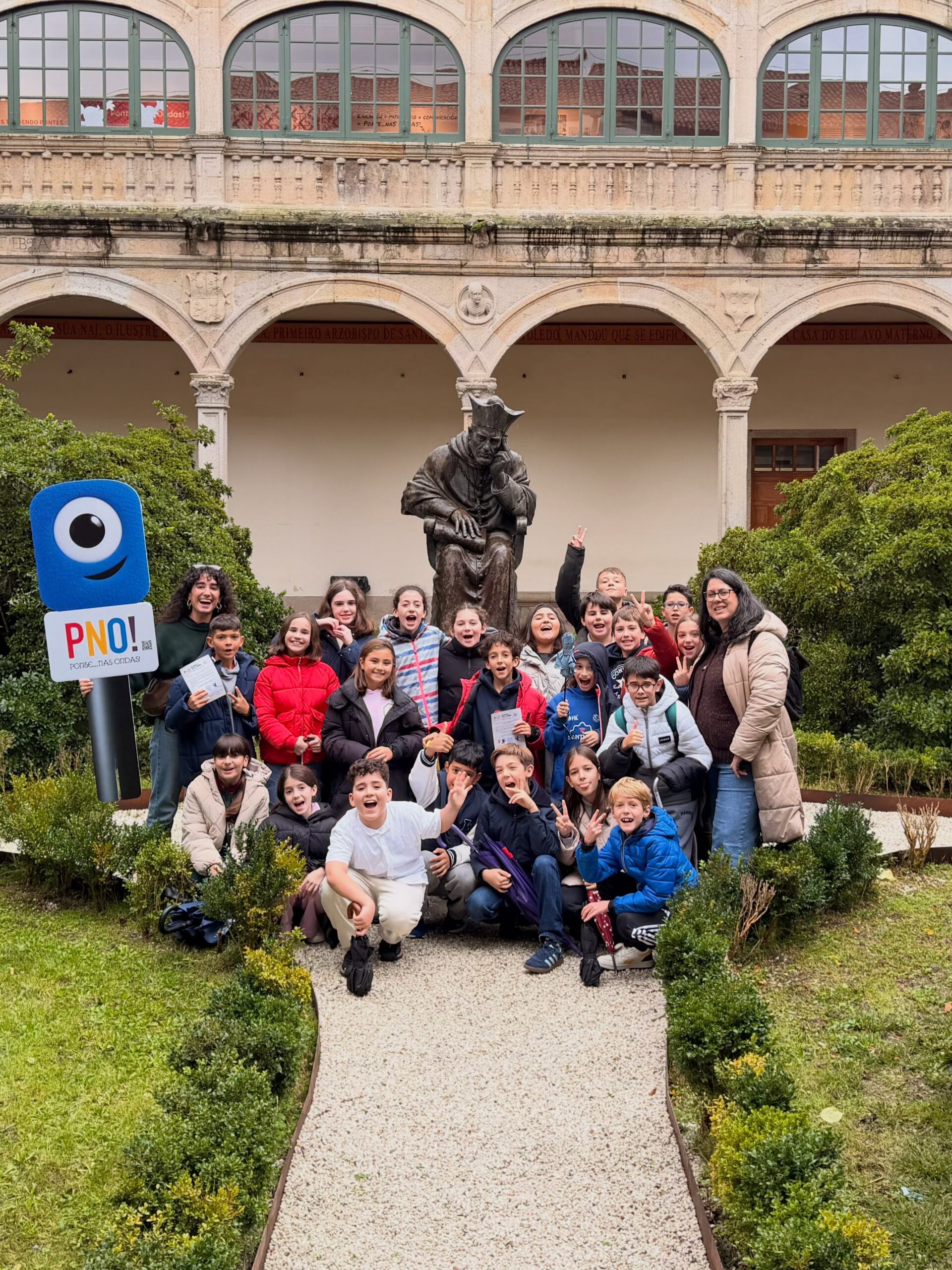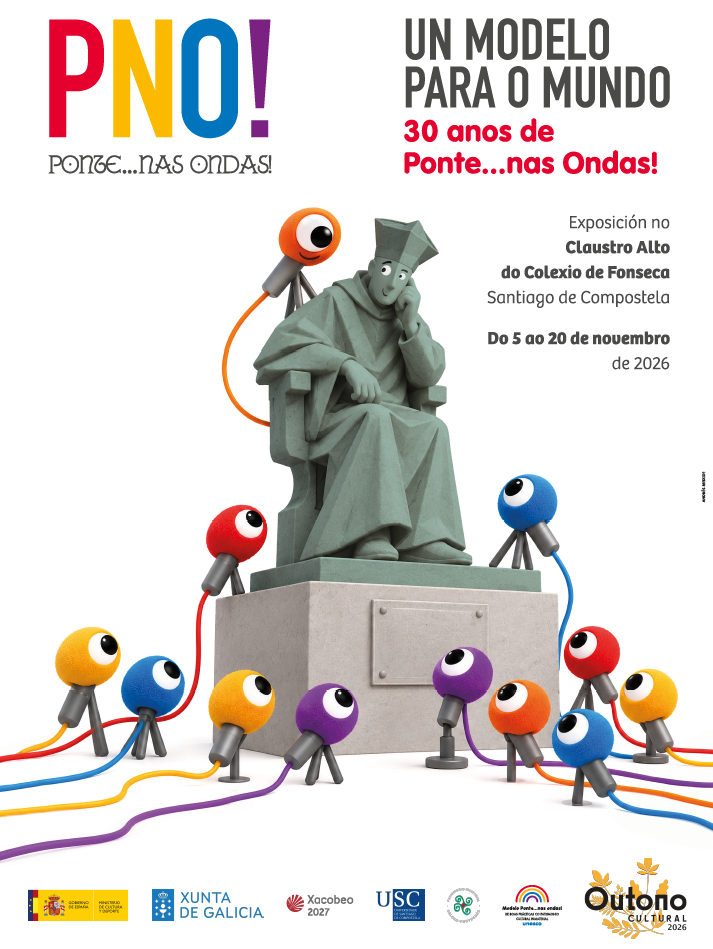


• The exhibition “A Model for the World. 30 Years of Ponte… nas Ondas!” closed its doors this Friday at the Upper Cloister of Fonseca, following two weeks of guided tours, radio workshops and a training day attended by nearly eighty teachers.
• The exhibition remains accessible online: its digital version will stay permanently available on the association’s website as an educational resource for all schools.
The exhibition A Model for the World. 30 Years of Ponte… nas Ondas! closed its doors this Friday at the Upper Cloister of Fonseca College (University of Santiago de Compostela – USC), bringing a very positive outcome: more than 300 schoolchildren from around ten educational centres across Galicia visited the exhibition to discover the history of a project launched in 1995 on both banks of the River Miño and recognised by UNESCO in the Register of Good Safeguarding Practices for Intangible Cultural Heritage. This figure is complemented by members of the general public and the nearly eighty teachers who took part last Monday in the training day of the PNO! Network of Model Centres, held in the Main Hall.
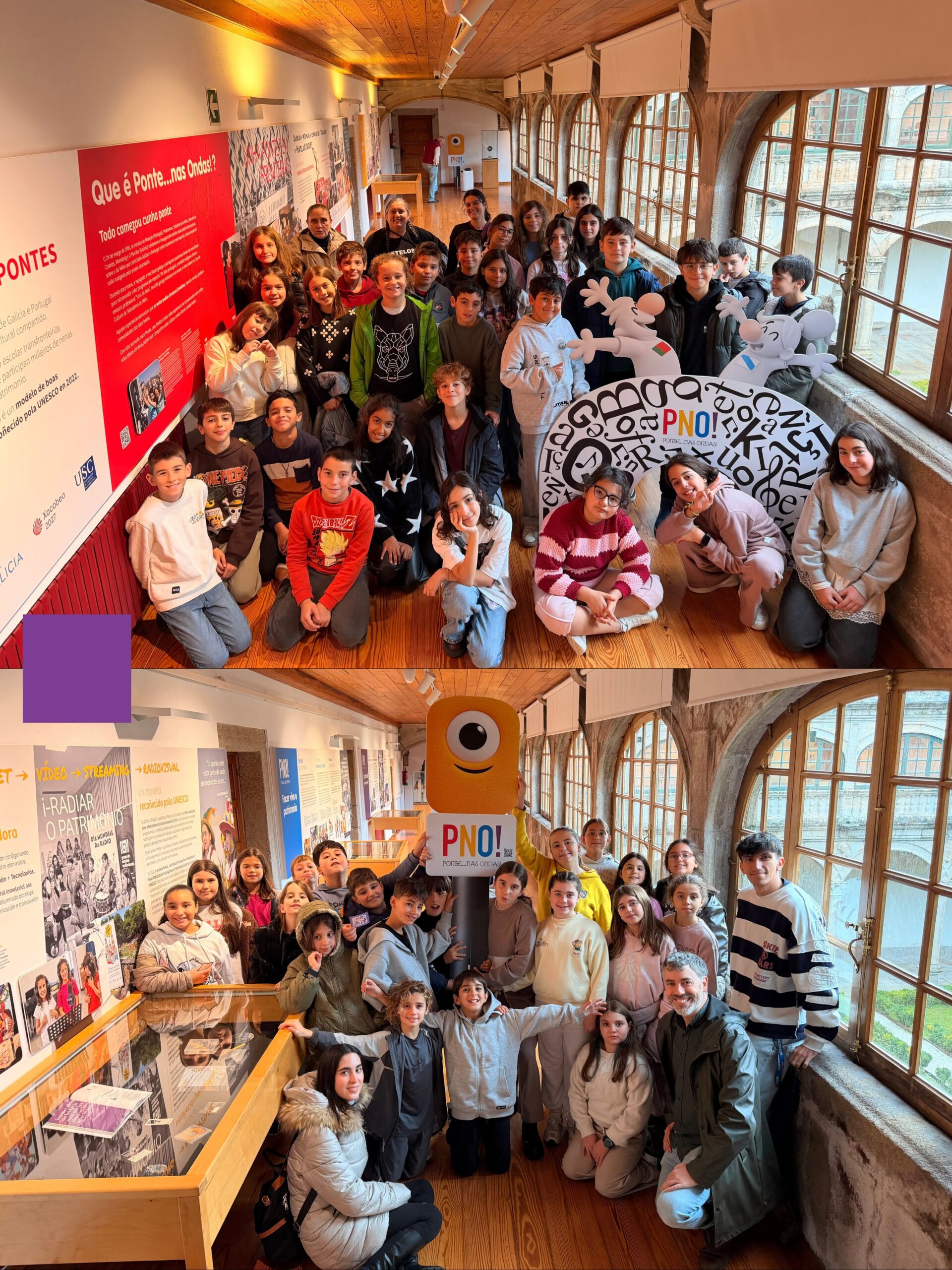
From cassette tapes to the radiovisual format: a journey through memory and technology
Conceived as “the tip of the iceberg” of the vast archive accumulated over three decades, the exhibition offered students a visual and sound journey to understand the concept behind the association’s name: a threefold bridge connecting Galicia with Portugal, younger generations with Intangible Cultural Heritage, and the entire community with the Lusophone world.
One of the displays that attracted the greatest attention and amazement during the guided tours, led by journalist José Manuel Diego, was the showcase recreating the project’s technological timeline. Accustomed to streaming platforms and mobile phones, students stopped in fascination before objects that seemed almost archaeological to them: the first cassette tapes used to record the initial broadcasts, old computer floppy disks and the first compact discs (CDs). These physical testimonies show how Ponte… nas Ondas! has successfully adapted the technologies of each era to educate and teach people how to communicate.
Through exhibition panels, old photographs and recordings, students were also able to understand what it means to “keep heritage alive”: from discovering how pandeireta rhythms reach the classroom thanks to recordings collected from older people in rural villages, to seeing how school radio has spent thirty years giving a voice to local traditions and recovering memories “from grandparents” in order to “pass them on to the memory of younger generations”.
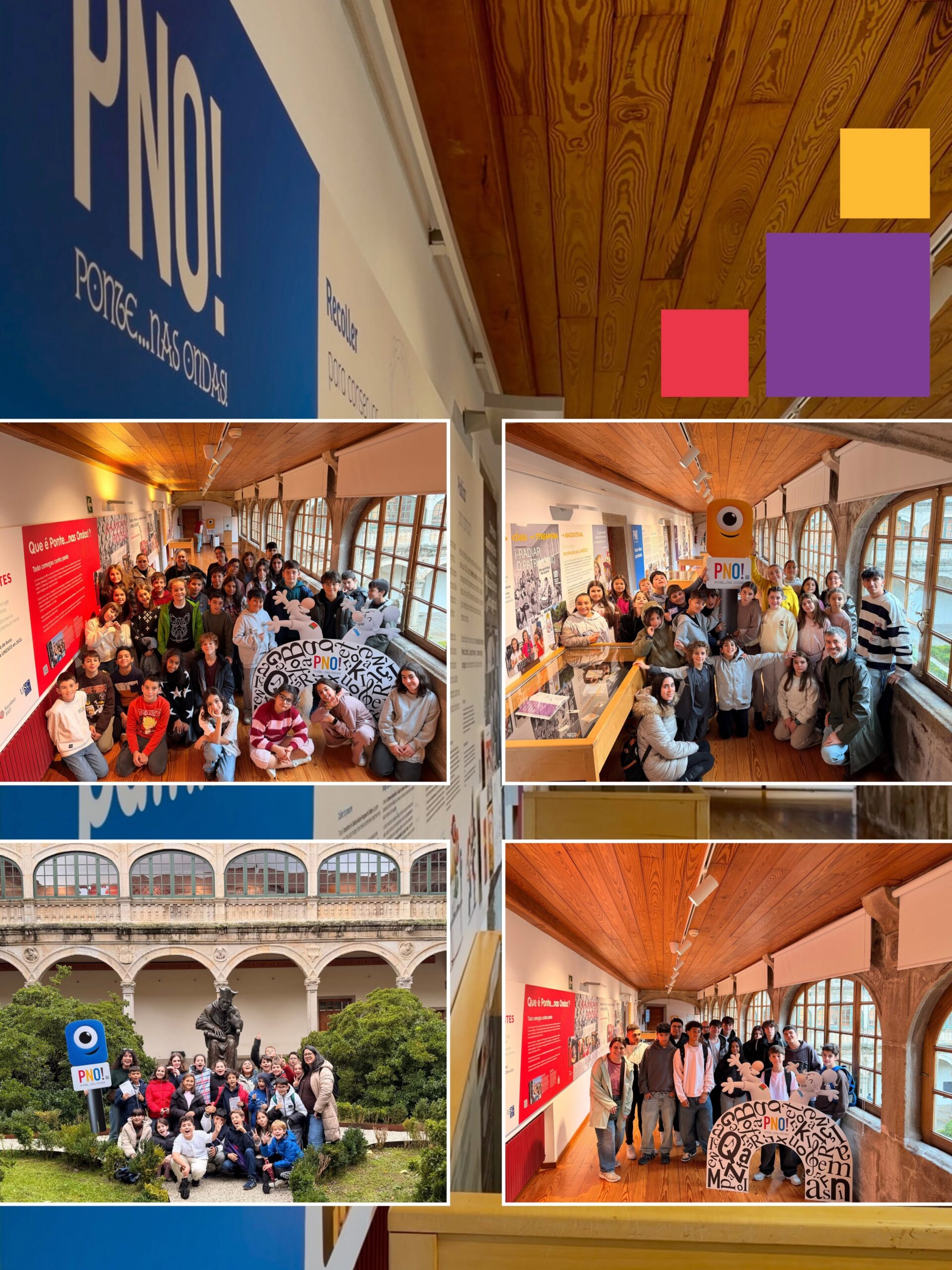
A new generation of radio talent at the Fonseca Chapel
True to its learning-by-doing philosophy, each visit included a practical workshop at the radio studio set up in the University Chapel, led by Damián Alonso. For many of the schoolchildren, it was their first time sitting in front of a professional microphone.
Far from being intimidated, the students showed great confidence behind the microphones and recorded their own programmes, talking about traditions and celebrations in their homes and communities: Samhain, Christmas, popular legends and traditional games. The experience demonstrated that, despite living in an age dominated by visuals and screens, there is still a new generation of radio talent, and that students value spoken communication as a way of sharing their own perspective on heritage. These podcasts will be published on the association’s website in the coming days.
The exhibition remains open online
Although the physical exhibition has now left Fonseca, the journey through the 30 years of Ponte… nas Ondas! will remain permanently available in digital format on the association’s website (pontenasondas.org). Students can also continue to take part in the prize draw associated with the exhibition until tomorrow, Sunday 22 November.
The exhibition was coordinated by Santiago Veloso, with texts and documentation by Roberto Noguerol, graphic design by Andrés Meixide, exhibition design by Lía González, video production by Casa de Tolos, workshops led by Damián Alonso, language editing by Uxía Iglesias, production by José Manuel Diego, and mediation services managed by Closet Comunicación.
The project was funded by the Ministry of Culture and the Xunta de Galicia (Xacobeo 2027), with institutional support from the University of Santiago de Compostela (USC), as part of its Outono Cultural 2026 programme.